
FROM THE STUDIO | Paula's Parting Words of Wisdom
Editor’s Note: For the first time in over half a decade, GOAT is now operating without Paula Bechara, our longest tenured team member and the heart of our studio. After an emotional week of goodbyes, she has moved on to the next phase of her life & career. While at GOAT, Paula grew from a shy, young designer to an Architect (emphasis on the capital ‘A’), leading projects in the studio and in the field. As much as we would like to take credit for her development, the below essay is a testament to the intentional effort she put into her career. As a parting gift to the future versions of herself that will one day join our team, Paula left us with this sage collection of tips to navigate the licensure exams. Tips whose wisdom I can personally attest to; in an atypical transposition of roles, Paula preceded me in the ARE process by a few months and acted as my mentor. Her guidance (and study materials) helped give me the confidence to take care of something in a few months I had been postponing for many years. Peter and I are so thankful for Paula, the vital work she did for us, and the culture she was so crucial to building at GOAT. And I know that future architects will be just as thankful for the personal counsel she offers us below.
Colin VanWingen, AIA
GOAT Principal + Co-founder
A Guide to Crushing the Architect Registration Exam
Paula Bechara, AIA
If you are reading this, there is a good chance you are either on the verge of your first ARE test or you are currently knee-deep in study guides, feeling the weight of the process. If that’s you, I want to start with a massive congratulations.
You’ve already conquered the hardest part: getting started.

Hasta luego, Paula
In the wise words of my father, "Lo que no se empieza, no se termina. Así que, no dejes para mañana lo que puedes hacer hoy” [What you don’t start, you don’t finish. So don’t leave what you can do today for tomorrow.] It sounds simple, but in the world of architecture, where we are prone to perfectionism and over-researching, starting is often our biggest hurdle. Let this be your push.
The Journey
My journey was as straight as the Mississippi river. It took me two years of thinking about taking the tests and another four years of on-and-off studying/testing. I spent a long time looking for the "perfect formula" for success, only to realize it doesn't exist.
When I first decided to get serious, I fell into the classic perfectionist trap. I focused on the "aesthetic" of studying: the perfect study material, the right colored markers, color-coordinated notebooks, planners, and a pristine designated study area. I made endless flashcards, researched and purchased all books I needed to read, and sat through every Amber Book video. I had a plan to finish all six divisions in two years tops.
But life, both the good and the bad, always has a way of getting in the way. It is very easy to find an excuse not to sit down and study when you’ve made the process feel like a monumental, life-altering chore.
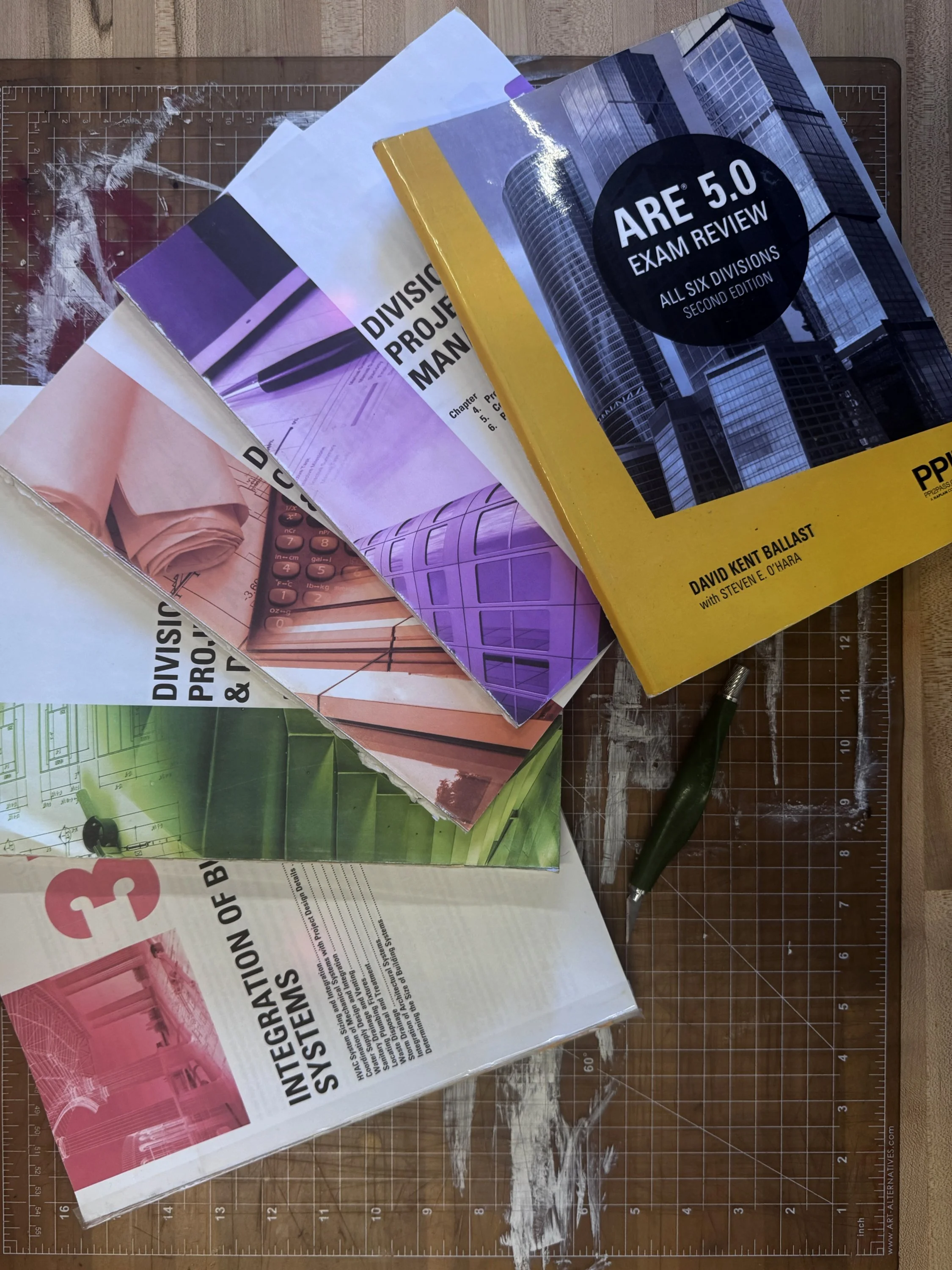
“Break it into manageable pieces'“ is not a metaphor
Stop Preparing to Study, and Just Study
If I could go back, I’d tell myself to stop focusing on the markers and start focusing on the material. Here is the practical reality of how I actually made progress:
Ask Questions at Work: Your office is a living textbook. If you’re studying for PDD, take a stab at trying to annotate a wall section by yourself. If you’re on PjM, ask your principal how they handle contracts and task management. Real-world context sticks better than a textbook ever will.
The 3-4 Week Rule: Don't let your study window drag on for months. I found that scheduling the test just 3 to 4 weeks out from when I started studying kept me focused. Anything longer and I would start to forget what I learned in week one.
Break it into manageable pieces: Books like the Ballast manual are intimidating. I literally broke my book into each test section so that it didn't feel so overwhelming. Taking it one test or even as little as one chapter at a time prevents the "task paralysis" that sets in when you look at the whole mountain at once.
Learn the concept, not the solution: The most daunting part is how much material, formulas and code concepts you need to know. What worked best for me was not to focus on memorizing the material but understanding how and why that decision was made. Practicing architecture is a series of problem-solving tasks. Knowing the why some solutions work better than others would make you a better architect in the long run than just memorizing the material. Especially in a world where new solutions are always on the horizon.
Group Your Exams (Work Smarter, Not Harder)
One of the best tactical moves you can make is grouping your tests. I recommend splitting them into Administrative Tests (PcM, PjM, and CE) and Design/Technical Tests (PA, PPD, and PDD).
By grouping them, you ensure that the topics overlap. You’ll find that studying for one naturally prepares you for the next, minimizing the "re-learning" phase and keeping your momentum high.
The Power of an Emotional Support Study Buddy
The process of licensure can be a lonesome one. If you are like me, get yourself a study partner. This isn’t just about someone to quiz you; it’s about emotional support. You need someone to keep you on track when you want to binge Netflix instead of reading contracts. More importantly, in the event that a test does not go as planned, you need someone to lift you up and remind you that a "fail" is just a data point, not a definition of your worth.
If You Fail, Keep Moving
This is the hardest pill to swallow: If you don't pass, don't stop. Move on to the next one.
There is a high probability that by continuing to study for a different division, you will actually gain the specific knowledge you lacked for the one you missed. The exams are interconnected. Sometimes, seeing a concept explained in the context of "Project Management" makes it click for "Construction Administration."
In Conclusion
If you take one thing away from my "rant," let it be this: Be gentle with yourself.
This process is designed to wear you out. It is a marathon of endurance, not a sprint of intelligence. There is no "correct" timeline. Just because someone else finished their exams in six months or passed every test on the first try does not mean they are a better architect than you. It simply means they were better test-takers at that specific moment.
Architecture is about more than a three-hour 100 question multiple-choice exam. It’s about how you solve problems, how you design for people, and how you show up for your team. The license is a milestone, but the resilience you build during this process is what will actually make you a great architect.
So, pick up the book (even if you don't have the right colored marker yet). Start today. You’ve got this.
Editor’s Note: The title of the essay is from me. Always humble, Paula will hate it. Miss you!